A lot of the "scratches" people show us on hardwood floors come off with a damp cloth.
That's good news, and it's also the reason to slow down before buying a scratch repair kit or calling a refinisher. Marks on wood floors fall into three groups, and each one has a different fix. Some you can handle in five minutes. Some a cleaning will improve. A few need someone with a sander, and that's not us.
A quick word on why this matters in Lexington specifically. Most of the yards around here are sandy, and sand is harder than any floor finish made. Every grain that rides in on a sneaker is a tiny piece of sandpaper. Floors in newer subdivisions with fresh sod and bare dirt beds tend to scratch faster in their first couple of years, simply because there's more loose soil around the doors.
So start by figuring out which kind you're looking at.
Telling the three apart
Clean the spot first. Dry grit and old residue can make a shallow mark look much deeper than it is, so vacuum or dust mop the area, wipe it with a barely damp microfiber cloth, and let it dry. Then look again in good side light, and run a fingernail across the mark.
Scuffs
A scuff sits on top of the finish. It's usually a gray or black streak from a rubber shoe sole, a chair leg, a toy truck, or a suitcase wheel. Your fingernail glides right over it without catching. Scuffs are transfer, not damage: something left a bit of itself on your floor.
Scratches in the finish
These are fine lines that catch the light and often look white or lighter than the floor around them. Your fingernail might catch a little, or not at all. The finish is cut, but the wood underneath is fine. Pet nails, grit under shoes, and dragged furniture make most of them. On a lot of floors, they're spread across a whole traffic lane as a dull haze made of thousands of tiny ones.
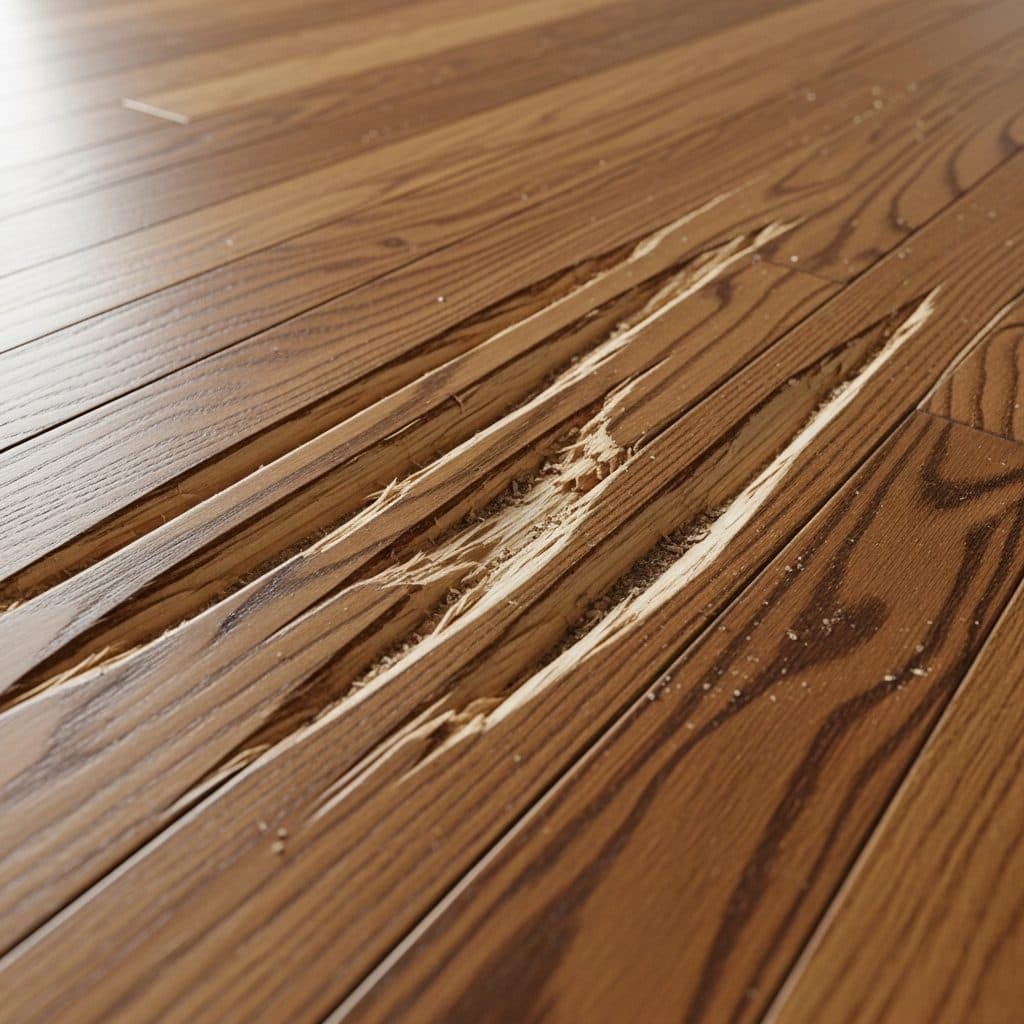
Deep scratches and gouges
When the line looks darker than the floor, the cut has gone through the finish into the wood. Dirt settles in the bare wood and darkens it. Your fingernail catches clearly. A gouge is worse: a dent, a divot, or a chip where wood is crushed or missing. Dropped cast iron pans, a dragged dresser, and a big dog taking a corner at full speed are the usual causes.
What you can fix at home
Scuffs are the easy win. Put a little hardwood-safe cleaner on a microfiber cloth, not on the floor, and rub the scuff gently with the grain. Wipe it dry. Stubborn rubber marks sometimes need a few more passes or a dry tennis ball rubbed over them. If you feel grit under the cloth, stop and clean the area again first, or you'll trade a scuff for a scratch.
Light finish scratches are harder. You can't really erase them by cleaning, but you can make them a lot less obvious. Residue and dirt sitting in and around the scratch are what make it stand out in the light. A careful, low-moisture clean of the area often makes a scratched lane look noticeably more even.
Some tools and products are worth skipping:
- Steam mops. Heat and moisture together are hard on most finishes.
- Melamine sponges and scouring powder. They dull the finish around the mark, so now you have a dull patch with a scratch in the middle.
- "Shine restorer" and polish products. They fill fine scratches for a few weeks, then turn cloudy, collect dirt, and make the next real cleaning harder.
- Spot sanding at home. It almost always leaves a halo where the sheen doesn't match the rest of the floor, and that halo is more noticeable than the scratch was.
Deep scratches and gouges are the honest limit. Cleaning can get the dirt out of the groove so it looks less dark, and that's worth doing. It can't put wood or finish back where they've been removed.
When to call a refinisher, and when to call us
We clean hardwood floors. We don't sand floors and we don't put coatings on them. So here's the plain version of who to call.
Call a flooring or refinishing company if you have gouges, deep scratches through to bare wood, a board that's split or cupped, or traffic lanes where the finish is worn completely off. Depending on how widespread the damage is, that might be a single board repair, a refinish of one area, or the whole floor.
Call us if your floor is mostly scuffs and finish-level wear and the whole thing just looks tired and grimy. Our hardwood floor cleaning is a pH-neutral, low-moisture clean that's safe for finished solid hardwood, engineered floors, and prefinished planks. It lifts the built-up residue and soil that make scratches stand out, and a lot of floors look years younger afterward even though the scratches are technically still there.
It's also a good idea to clean before you get a refinishing estimate. Once the grime is off, you and the refinisher can see what's real damage and what was just dirt, and sometimes the job turns out smaller than you feared.
Stopping new marks from showing up
Nearly every scratch starts with grit or with something dragged. So the prevention list is about those two.
Every exterior door wants two mats: a rough one outdoors, a softer one just inside. Dust mop the entry paths most days, because sand is at its most damaging in the first fifteen feet inside the door. Vacuum with the beater bar off.
Put felt pads under every leg of every chair and table, and check them every few months. A pad that's worn thin or has a pebble stuck in it is a scratch waiting to happen. Lift furniture when you move it. Use a piece of cardboard or a moving blanket under anything heavy.
Keep pet nails trimmed. If the dog has a favorite launch spot by the back door, a washable runner there saves a lot of finish.
Watch the wheels. Office chairs on bare hardwood wear a gray circle into the floor within a year or so. A chair mat stops it.
If you've done the fingernail test and you're still not sure what you've got, ring 803-310-5135 and describe what your fingernail found. We'll be straight with you about which list it belongs on: ours, or a refinisher's.