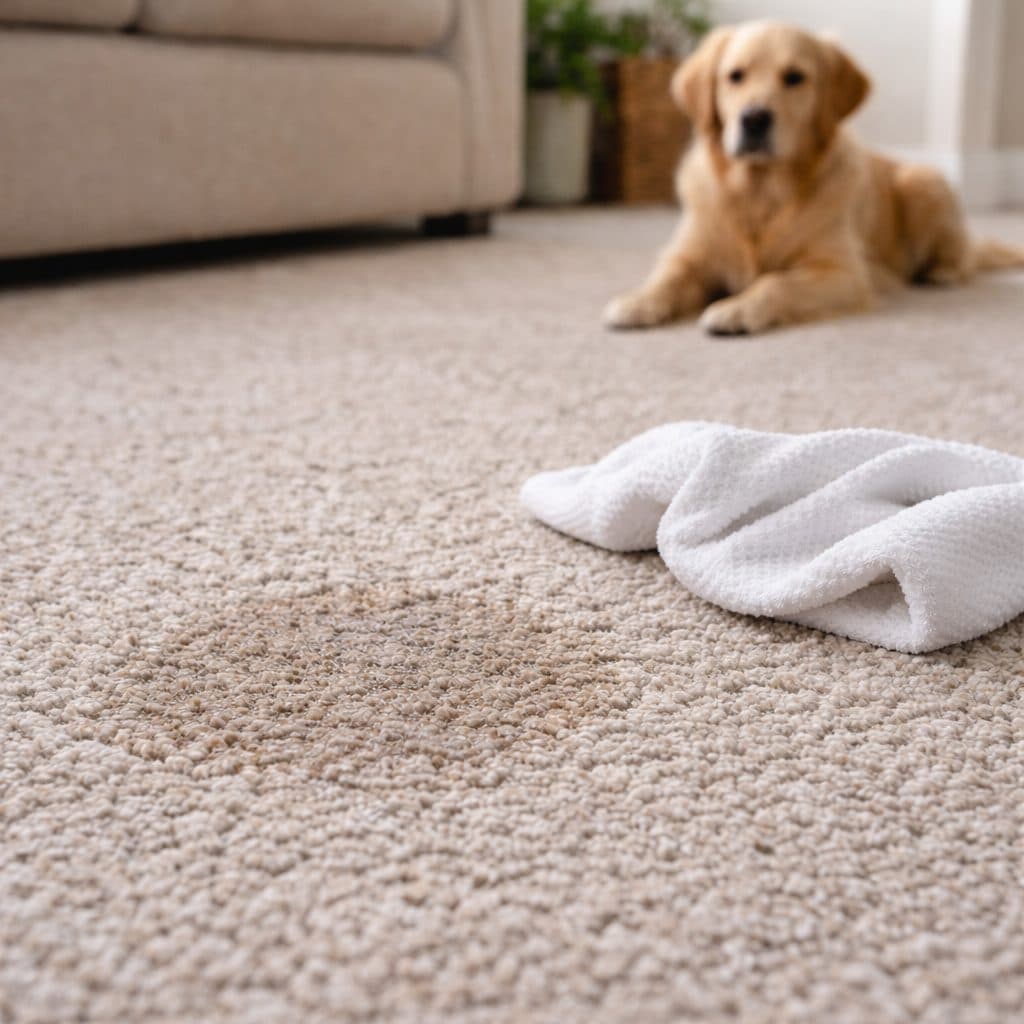
Call it ten minutes. That's roughly the window you have after a pet accident before the urine has soaked past the fibers and into the backing. What you do in that window decides if you end up with a stain you can fix or a smell that shows up every humid week for the next year.
Right after the accident
Minute one: get the pet out of the room and grab a thick stack of paper towels or an old white towel. Colored towels can bleed dye onto light carpet.
Minutes two through five: blot. Press straight down, hard. Standing on the towel works well. Swap to a dry section, press again, and keep going until the towel comes up barely damp. Work from the outside of the spot toward the middle so you don't spread it. Don't rub. Rubbing frays the fibers and grinds the urine sideways into a bigger patch.
Minutes five through ten: if there's solid mess, lift it first with a plastic scraper or the edge of a card. Then, if you have one, apply an enzyme cleaner made for pet urine, enough to reach as deep as the accident went. Skip anything with a strong fragrance and skip bleach entirely. Don't pour water on it. Extra water drives the urine down into the pad, and that's the one place you can't easily reach from the top.
After that, let it air-dry with a fan on it and keep the pet off it until it's fully dry. Mark the spot with a piece of tape so you can point it out later.
Done right, a fresh accident often never becomes a problem. The trouble is that a lot of accidents turn up days later, by smell, or not at all until the room starts to stink in July.
If you find it days later
Skip the blotting, since there's nothing left to pull up. Go straight to the enzyme cleaner and use more of it than seems reasonable, because it has to reach as far as the urine traveled while it sat. Cover the spot loosely with plastic wrap so it stays damp long enough to work, often overnight, then uncover it and let it dry. An old spot may take two or three rounds. If it still smells after that, it's past what a bottle can do.
Why some spots need more than you can do
We wrote a whole post on why pet odor keeps coming back, so here's the short version. Urine that reaches the pad dries into salts that release odor again whenever the air gets damp, and bacteria feeding on it in the pad produce the sharp ammonia smell. A spray bottle reaches the top. A rental machine reaches the top and adds water underneath. Neither one gets the enzyme down to where the urine sits.
There's also a difference worth knowing between deodorizing and odor removal. Deodorizing puts a scent over the smell, or absorbs a little of it, and it fades in days. Removal breaks down what's making the smell. Plenty of products sold for pet odor are deodorizers with a pet on the label.
What our odor treatment does
Finding the spots you didn't know about
The first part of a visit is the technician walking the rooms with you, and on a pet job that walk is half the work. The strongest smell in a room often comes from somewhere other than the visible stain, like the spot behind the recliner or the stretch of wall where the cat goes when nobody's looking. Old dried urine is easy to miss in daylight, so we look carefully, and you'll see what we find before anything gets treated. Then you get the price, so there are no surprises.
Getting the enzyme to the pad
Each spot gets our live enzyme treatment, applied in enough volume to follow the urine down past the backing to the pad. The enzymes digest the urine itself, crystals and bacteria included. That takes time to work, so it isn't rushed.
Cleaning without flooding
Then the whole carpet gets our regular clean. It's a low-moisture process with no soap. Nothing sticky stays in the fibers to grab dirt off paws, and no flood of water reaches the pad to stir up whatever's left. Most rooms are dry enough to walk on soon after we finish, which matters when you've got a dog who wants his room back.
Being straight about results
Most pet odor improves a lot with proper treatment, and most stains come up. Some don't. Urine can permanently change the color of carpet fibers, especially on light carpet with an old spot, and a stain like that may lighten without disappearing. Spots that have been used over and over for years can soak the pad so badly that the honest answer is replacing the pad under that section, and sometimes treating the subfloor too. If that's where your carpet is, the technician will tell you during the walkthrough, before you pay for a treatment that can't do the job.
One recent visit
A homeowner here in Lexington County called us about a carpet that had a little of everything: general soil in the main rooms, a few traffic lanes, and several pet spots that had been cleaned at home more than once and still smelled on damp days. She told us later that scheduling had been easy, and that the price was fair for what got done.
The technician checked the whole room, including the corners she hadn't thought to mention. Every spot got treated at the pad, then the whole carpet was cleaned. She mentioned afterward how friendly and polite he'd been, and said that counted for a lot with a stranger in her house for the morning. That's the visit we try to make every time: find all of it, treat it properly, be honest about the result, and be decent company while doing it.
Getting it handled
If you've got spots that keep coming back, read up on our odor treatment, and check the coupons page for the current $25 off pet treatment. On the phone at 803-310-5135, tell us roughly how many pets, how long it's been going on, and what you've already tried. It helps us plan the visit, and none of it will shock us.